
Performance Reviews Are Shit (And We Should Stop Pretending Otherwise)

It’s the beginning of the year, which means performance review season—the thing everyone does and almost no one believes in. I’ve had two reviews that permanently shaped how I think about managing people:

My “best” performance review gave me top marks in every category. Every box checked. Endless attaboys. It came from one of my most respected people managers, jumping in circles to tell me so many different ways that I was doing a great job. …and then explaining that I was getting the standard “meets expectations” 3% raise. The same raise you got if your performance was fine. Not exceptional. Just… basically showed up for work every day.
That review was glowing. And it was infuriating. I walked out feeling confused, unmotivated, and honestly a little insulted. If that was my best review, what exactly was I supposed to do differently? Work harder? Care more? We were at a startup. They already owned my soul.
My “worst” review went in the opposite direction. My SVP took me to his old boy’s golf club for lunch. He ordered me a drink. The first words out of his mouth after they delivered our drinks were, “So, have you always had trouble with people not liking you?”
Seriously. That was the opening line. No examples. No coaching. No clarity. I choked up and spent the rest of the lunch trying not to cry because I was so shocked and mortified. I’ve had lots of feedback in my life, but it was never that I had a likeability problem. I left that lunch feeling small, defensive, and deeply clear on one thing: I did NOT fit in here.
Those two experiences sit at opposite ends of the spectrum, and yet they led to the same outcome: Neither made me better, helped me grow, or increased my sense of fulfillment. And after living through both ends of the performance review spectrum (and everything in between), I’ve come to a pretty firm conclusion: Most performance review processes are shit.
They’re not just ineffective, they are actively demotivating. They make people defensive. They reward performative behavior and calculated changes instead of real growth or fulfillment. And somehow, year after year, we keep pretending they’re a necessary evil instead of admitting the obvious: They don’t work.
Traditional reviews are backward-looking, overly structured, and weirdly impersonal for something that’s supposed to be about people. They focus on what went wrong, what needs to be “fixed,” and how someone measures up against a scale that was never going to capture their real value anyway. Tie that to compensation, and you’ve officially guaranteed that honesty is dead on arrival.
That’s not growth. That’s kabuki.
Ok, so you’re in charge—now what?
As Wheels Up Collective has grown, we’ve been thinking a lot about how we incorporate intentional feedback into our process. And we’re definitely not going to pretend some model fits us just because it’s familiar. We’re a tight-knit team by design. We hire exceptionally high performers by default—most of our team is senior, experienced, and already deeply self-aware. They don’t need an annual ritual to tell them how they’re doing—they already know.
At the same time, we do have junior teammates who deserve real coaching, clarity, and support. And “real” is the operative word here. Not a once-a-year reckoning. Something that actually helps people get better.
So instead of asking, “How do we do reviews the right way?” we started asking a better question: What would it look like to throw the whole thing out and build something that actually reflects how great work happens?
It’s been something Elise and I have been chewing on for a few months now. And it’s helped me codify some pretty strong beliefs about managing people:
1. You can’t change people.
After a solid two+ decades of managing teams, I believe pretty strongly that people don’t change. You can’t change them. What you can do is help people do what they’re already good at better. You can put them in roles that fully leverage their strengths. And you can remove the unnecessary friction that consistently gets in their way.
2. People want to do good work.
We’ve been super lucky to hand pick our Wheels Up team. They are all exceptionally high achievers. It’s an easy and reasonable assumption (every time) that everyone here wants to do excellent work on every project. When something misses the mark, my first assumption is never that someone didn’t care or didn’t try hard enough. It’s that something in the system failed them: The assignment wasn’t clear; the timeline was unrealistic; the tools were clunky; priorities were muddy. Somewhere along the way, something broke—and nine times out of 10, that “something” is process, not people.
3. Managers need to manage.
Management is not a title or a promotion. It’s a commitment. If you manage people, you are directly responsible for your people’s success. That means coaching, paying attention, and making the people in your care better every day—not once a year when it’s time to fill out a form.
Good coaching is constant. It’s in the small conversations. It’s in clearing obstacles early. It’s in fixing the environment instead of blaming the person. If feedback only shows up on performance review day, something has already gone wrong.
4. Team members thrive in the sweet spot.
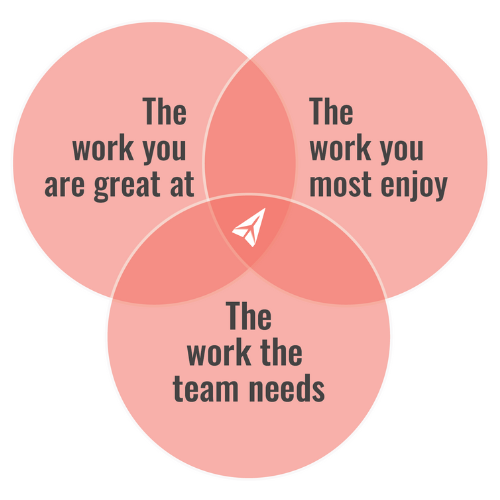
People thrive when their role sits at the intersection of what they’re good at, what they like doing, and what the business actually needs. Miss one of those and you get burnout, frustration, or mediocre output. Hit all three and you get momentum, flow, and people who genuinely care about the outcome. I believe that every single team member needs to have at least 60% of their day-to-day work squarely in this sweet spot, and leadership and managers need to intentionally design for this when hiring and delegating work.
5. You have to make it easy to be great.
We’ve all experienced flow—that feeling where you sit down, focus, and just crank it out. For high performers, that state is everything. My goal at Wheels Up is to build a system, an environment, and a set of tools that make flow the default, not the exception. That means fixing the silly things that drive smart people crazy and quietly drain momentum over time.
6. Money changes everything.
I’m pretty adamant that our process should not be tied to compensation. When money is on the line, people stop being honest and start playing defense. Growth becomes about optics instead of learning. We’re not interested in that tradeoff. And no matter how much more money you get, it’s hardly ever enough to feel appropriately valued or appreciated. As a growing company, we’re still calibrating how we balance profit sharing and compensation increases. But Elise and I committed to making sure our comp and benefits make people feel valued, and with skin in the game.
My goal as CEO is for Wheels Up Collective to be the last place our teammates ever work. We want to keep them perfectly challenged, respected, and supported in doing the best work of their careers, so they never even think about going somewhere else. Any “review process” we implement needs to fall in line with achieving that objective. It’s still a work in progress. But if you want to see how it turns out, let me know. (Or if you have a great review process that thinks like I do, I’d love to hear about it!)


