
Getting Found in the Age of AI: How to Get Your Local Business Noticed

This morning I had the privilege of presenting at the monthly Aiken Chamber of Commerce breakfast: First Friday Means Business. Their president, Jim Tunison, reached out to me a couple months ago with the invite after seeing our guide: AI SEO for Marketers. "Can we share this with our members? And would you consider giving a workshop on it?" You bet, and you bet!
Side note - I never expected to be able to connect with such a vibrant business community when I relocated to Aiken. There's so much happening in this small town to inspire and foster innovation and entice startups to the area. Talking shop with business owners is my absolute favorite part of my job, and this morning's event has me buzzing.
Since it's a topic that is on many business owner's mind, we're sharing the presentation and free resource links here, along with my notes. I hope you find it helpful! And if you are looking for a partner to help you get your small or local business found, check out our new Digital Marketing Packages for Small and Local Businesses, then drop me a line!
Without further ado, here's the presentation, the links to the resources I mentioned, and my notes:

Hi I’m Amy Winner, co-founder of the marketing agency, Wheels Up Collective. We’re spread across the country but I’m based here in Aiken. We’re members of the Chamber - thank you so much for having me here this morning.

Obligatory self-promotion - Wheels Up is a boutique marketing agency that specializes in working with high growth companies. We all worked in the startup world before starting Wheels Up, and are used to tight timelines and even tighter budgets, so we’re always working to stay ahead of tech and trends to help our clients do more with less.
Today we’re talking about the evolution of search. SEO - search engine optimization - has been a mainstay of marketing tactics for well over 15 years.
It’s always been evolving - trying to decode the Google algorithm and make it to the top of the search ranking pages. (And when I talk about “Google” it’s a genericized trademark - this advice applies to all the new AI-based search tools like Microsoft Copilot, ChatGPT, Claude, and Perpexity, in addition to Google’s Gemini.
But as AI has become an ubiquitous part of online tools in the past two years, it is dramatically changing not only the way users search, but also how businesses interact with those web users, and the economics of how businesses advertise online.

Your business is already all over the web.
Over 80% of people do some sort of research online before making a big purchase, so how your business shows up when they do is something you need to think a lot about.
It’s a great time of the year to think about buying trends because I’m sure almost everyone here has been thinking about the holiday shopping season, either as a shopper or a seller. So if think about how you’ve done research recently - did you go to Google? Read reviews? Turn to established media outlets like consumer reports? Ask for advice on a local facebook group? Whose advice did you trust the most? How did you weigh credibility?
We like to think about this digital ecosystem in 3 buckets:
Some properties you “own” - like your website.
Some you “rent” or contribute to or pay for - like facebook, ads, and a google business profiles.
And some you have no direct control over - like review websites, and search engine rankings.

It used to be that when people talked about “search”, it was just the search engine results - the SERPS - search engine ranking pages - the organic results that come up when someone types a query into the google search bar.
It’s evolved to include all those places people turn for information as they move through their “buyer’s journey.”
It used to be that search engines wanted to provide the most accurate results possible in order to keep web users coming back. The more searchers they had, the more ads they could sell.
AI is drastically changing this Search landscape by cutting out the clicks and providing users with all the information they are looking for, without ever having to click through to another website.
This will drastically change the economics of their ads revenue, and also how websites are designed and promoted. It will change the kind of information that you are willing to click off google to get to.

Bear with me if you’re already an SEO pro, but I want to spend a quick minute talking about the old SEO versus the new AEO - or answer engine optimization.
SEO has curated results based on three things - technical, on page and off page signals:
Technical optimization handles things like site speed, image quality and size, crawlability, meta data, and mobile compatibility.
On-page optimization is the content on your site. Does it align with the right keywords, is it providing valuable information for site visitors. are you using the right code tags (like H1 for headlines) to tell the bot which copy is the most important.
Off-page optimization include the signals from other sites that you are reputable. Who links to you? Who talks about you? While you have complete control over the first two, off-page optimization work is a bit trickier.

I just want to take a minute to look at old search pages compared to the newer formats because I think it gives a glimpse into Google’s evolving search business strategy. These are screen shots from a search I did for “local flower shops near me”. It’s worth noting that your search results are unique - they are not only based on the search terms you type into the bar, but also where you are located, what your search history looks like, and what Google knows about you and what you’ve clicked on. That’s why if you google the same thing, you will get different results.
Right off the bat - Sponsored results. These are ads. Prime real estate, the coveted first three results. Note - most people don’t realize they are looking at ads!

Next is the Map Pack - which is one of the most successful placements in Google, and you can control if you are there and what it says. It pulls from Google Business Profiles, which are one of the most (if not THE most) valuable marketing tools for a local business. If you aren’t taking advantage of these, put it on your MUST-DO list for 2026.

At the bottom of the page, we finally get to the organic results. When we talk about “organic” rankings - these are not paid for. They are based purely on the google algorithm - which is a black box, and changes pretty consistently. If you have an SEO agency doing work for you, this is what they have traditionally been focused on. So maybe worth a conversation with them to see how they’re adapting their strategy to this new search world.

You’ll also find the “People also ask” section, which is Google trying to guess what your next question might be. Again, based on your search history, so these are usually pretty personalized. Case in point - I love Trader Joe’s and here it is, popped into a search about flower stores near me. These used to be called snippets and were a valuable part of SEO strategies to “win” very specific queries. Before AI Overviews, the snippets were one of the best ways to earn organic clicks.

Then we’re rounded out with more ads. These gallery ads also aren’t always recognized by searchers as “ads”.
In OLD search, Google wasn’t sure what you wanted to do, so it kind of threw the kitchen sink at you: ads, organic, snippets, maps. It took a bit of scrolling down the page to find what you were looking for, and organic information was at least half of the content on the page.
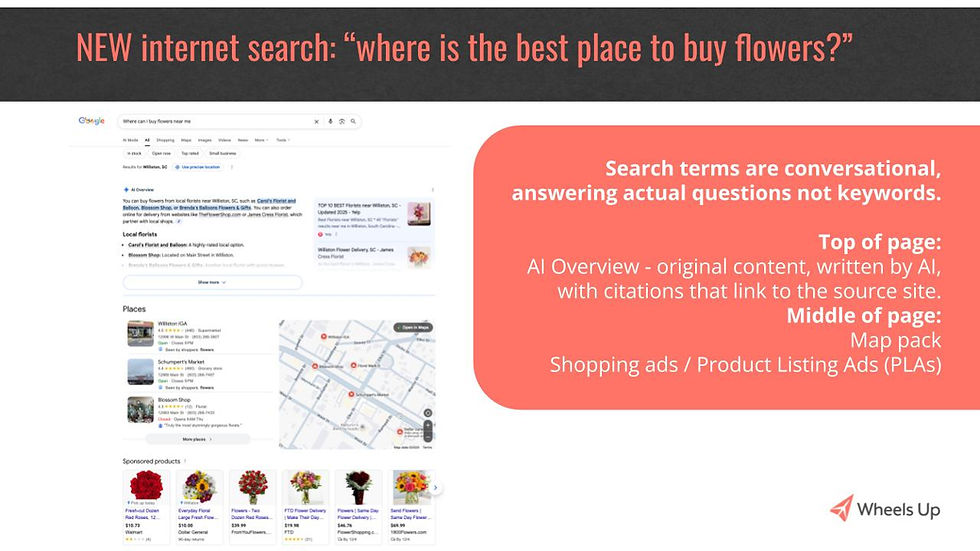
NEW search is geared towards conversational queries. People are typing in stream of thought questions instead of trying to guess which keywords would get them the information they were actually looking for. We were all conditioned to type keyword terms into the search bar - like “flower store, aiken” and now we are interacting with technology in a more conversant way.
This search page starts with an AI Overview. This is original content, written by AI, with citations that link to the source sites. It’s AI’s best attempt to answer your question for you, so you never have to click off the page onto another website.
Middle of the page still has your map pack, and then ads.

You have to scroll all the way to the bottom of the page to get to the organic rankings! And on some pages, there are only 3 or so organic links mixed in - so the way you think about promoting your website via google really has to change!
Google’s goal used to be providing valuable “directions” to help searchers go find the information they needed. Now it’s calibrated to serve up the exact information they are looking for - on a silver platter - without ever having to leave the Google domain.

So what does all this mean? The biggest change here is the web user’s behavior.
Now, over 60% of searches don’t ever result in a click outside Google search.
Those visitors are getting all the information they need, packaged in a convenient and highly consumable format, right from Google. What does that mean for you as a business? You better not be relying on just having a great website.

This leads to 3 pretty big challenges for businesses.
AI has already defined who you are to your potential customers - is it right??
Users are asking Google questions about specific problems they want to solve - so the way you position your products or services needs to match this slightly different angle.
You need to create information about your business that will train AI to tell searchers about your business the way you want them to.

This new approach is called Answer Engine Optimization. AI tools like ChatGPT or Google Gemini or Claude are powered by “large language models” or LLMs that pull information from all over the internet.
To get the best representation for your brand, think about three things:
A clean website - it loads quickly, the backend is sound with no errors, you don’t have broken links, etc - this is the “under the hood” part of your website, and you may or may not have access or expertise to tinker with it. A clean site also means clear navigation that not only makes it easy for the user, but also shows the hierarchy of your information.
Clear messaging - what you do, who you do it for, where you do it - it makes me crazy when i go to a local business’ website and their address is not listed anywhere. Or they assume that everyone knows exactly what they do. Please! put your business name, a description of what you do (that’s like 5 words or less), and your address in the footer of your site so it shows up on every single page.
Consistency - all that info about your business needs to be the same across all those digital properties - the hours need to match, the phone number, reviews need to talk about the same product names that you have on your website, etc.
Make it easy for the LLMs!!

Now that you’re all overwhelmed by all this… here are 2 pieces of good news.
If you’re already “doing SEO,” a few tweaks can align your efforts with AEO best practices.

And 2 - If you’re not, there are lots of things even the busiest business owner can do to make a big difference.

OK now we’re going to shift to the “What can I do about it?!” section of the talk. And even if you’re a small business, you can make a difference in this.
As you’re thinking about tackling some of these changes, keep these 4 things in mind:
Keep it clear and simple
Add structure with a clear hierarchy of information - headers, subheadings, bulleted lists, and tables. FAQs are great because you can answer exact questions - and also it tells AI that that’s what you are doing! The goal is to make your website’s copy easy for AI to find and use verbatim.
A website that has content added or updated regularly is a signal that it’s a vibrant business.
Credibility - add more depth to your content. include testimonials and data. and cultivate an authoritative voice - Answer engines learn patterns. When you repeatedly publish clear, helpful, accurate information in a consistent style, your site becomes associated with authority on that topic.

We’re going to dive into 4 things you can do to build yourself a plan to focus on building your AEO footprint.
Step 1. Cover your basics - consistency, clarity, mobile-first approach. I’ve got two links here to free tools you can use to run backend checks on your site to identify technical on-page issues and errors. Here are two free tools to help you find errors on your site:

Step 2. Figure out what AI thinks about you right now! Ask ChatGPT the questions your potential customers would, and see if you come up.
If you want to really dive down this rabbit hole, we have a checklist of 25 questions to ask Chat GPT to really understand how it thinks about you, your competitors, and your market.

Step 3. Define and OWN what you can - if you aren’t exploiting Google Business Profiles - you are missing out! We have a great (FREE!) ebook about how to do it.
Google your business and see everywhere it is listed. Make a list. Go look at review sites, social media, and directory sites - is your business name the same there? Contact info the same? Hours the same? Are there profiles you can update or add to? Make a list of your digital footprint and check back in on it quarterly to make sure it’s still accurate and up to date. This can take 15 minutes, once a quarter. Everyone has 15 minutes once every three months!

Step 4. After doing some research with ChatGPT in step 2, map out a plan for what changes you want to make to the way AI understands your business, and brainstorm the content changes you can make to help with that. It doesn’t have to be rocket science. You can add a little bit at a time- publish blog posts about misconceptions or key products or offerings (ChatGPT can write you a great first draft in literally seconds if you give it some bullet points on your point of view - but please edit and make sure the tone is right). Set aside a half hour every other week to update your Google Business Profile. Add pictures with captions that continue your narrative. Start a FAQ and then keep adding to it. These are great because you are telling Google exactly what the page is: Frequently Asked Questions! Then you give the question and then the answer. It’s so easy for the AI tools to just grab this and drop it into the overview verbatim.
The Hubspot AEO Grader is a free tool that gives you a very clear “state of the union” for your website’s AEO-readiness, with actionable recommendations. It’s free and can give you a great starting point: https://www.hubspot.com/aeo-grader

Lastly, a BONUS one for you! This has nothing to do with Search, but is something we harp on with every single client. You need to have a defined list of your audience - their names and contact info.
You need to be able to speak directly to them - usually via email. Do not rely on another business to curate your database because it can disappear so quickly.
For example, you don’t “own” your fans on facebook. While you can post updates to your brand’s page, you have no control over which news feeds that shows up in. Facebook could make a change to their brand pages tomorrow and eliminate the ability for you to see the names of people who have liked your page. If that’s the only way you are talking to your customers - you’re in trouble.
You need to build your own database of contact information so you can reach out and engage with your customers, prospects, family, and friends. You need to have ways to keep building that database via an email newsletter signup, or curated list of customers. It doesn’t have to be a fancy CRM, a spreadsheet works great.
Organize them the best you can so that you can give them relevant information, not just a generic email blast.
It costs about 5x as much to get a new customer as it does to get an existing customer to come back - so keep track of who your fans are so you can help them buy from you again.
Respect CAN SPAM laws - you can’t just send mass marketing emails to people who haven’t opted in or that you’ve done business with.

Hopefully that was helpful and not overwhelming. You don’t have to do it all at once. You can spend a half hour a week and chip away.
SEO and AEO work never yields immediate results, but it can move the needle in 30 days. Pick 5 or so tactics that are do-able for your business and work them into your regular office work days.
Wheels Up can also do this work for you, too. So if you are considering outsourcing this or any marketing projects, we’d love the chance to talk to you about it! Our Digital Marketing Packages for Local Businesses are perfect for this exact type of work!
Want more great content like this, delivered to your inbox?


